Your Guide to Israeli Family Traditions and Culture

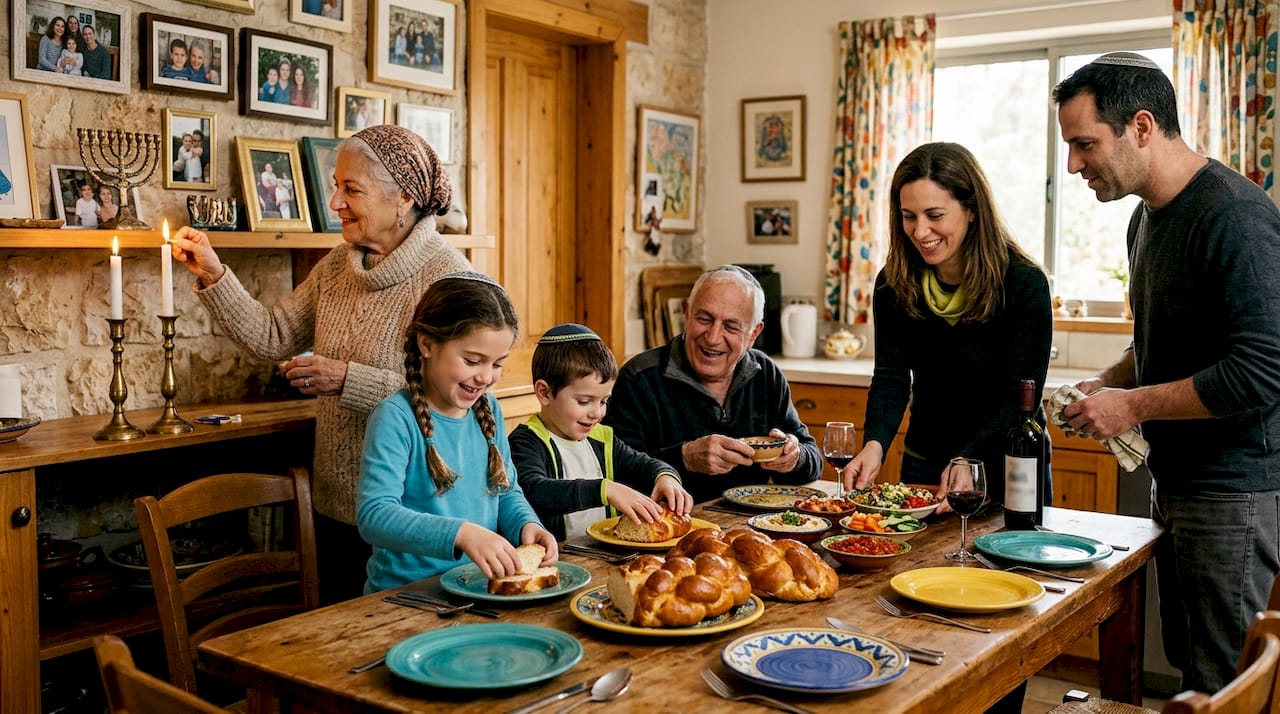
Israeli family traditions center on three things that rarely change regardless of how religious or secular a household is: fierce loyalty to family, a calendar shaped by Jewish holidays, and an instinct to pull the wider community into every celebration. Whether you’re planning a trip, preparing for a Bar or Bat Mitzvah in Israel, or simply trying to understand what makes Israeli family life tick, this guide covers the full picture. You’ll find everything from how family size varies by religious observance to why the Passover Seder functions as a national ritual, not just a private dinner.
A few things stand out immediately when you look at Israeli Jewish family culture through American eyes. Family bonds extend well beyond the nuclear household. Grandparents are active participants in daily life, not occasional visitors. And the Jewish holiday calendar doesn’t just mark time; it structures the entire year around communal gatherings that reinforce identity at every age.
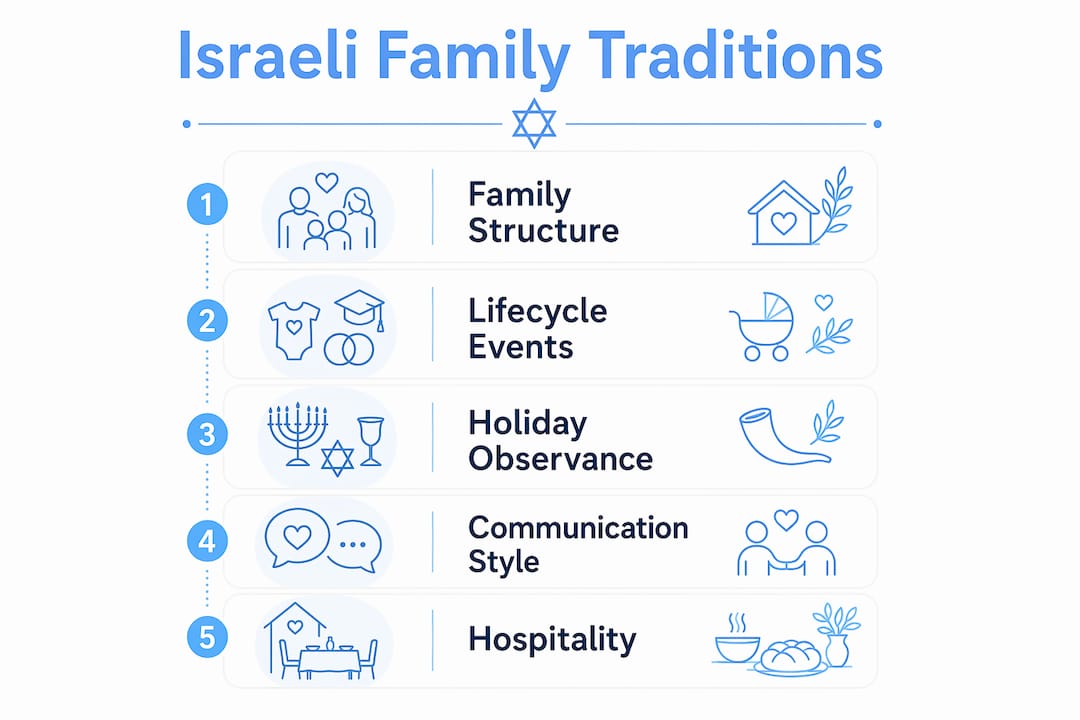
Israeli families range from small secular households to large Ultra-Orthodox families with large numbers of children
Multi-generational living is common, especially in religious and Mizrahi communities
Lifecycle events like the Brit Milah, Bar and Bat Mitzvahs, and weddings are community-wide celebrations, not intimate affairs
Passover, Shabbat, Purim, and Sukkot each carry distinct family rituals that vary by ethnic background
Communication is direct and warm, with fluid personal boundaries that can surprise American visitors
Hospitality is spontaneous and genuinely open-door
What does a guide to Israeli family traditions actually cover?
The term “Israeli family traditions” covers a wide range of practices rooted in Jewish religious law, ethnic heritage, and the particular social culture that developed in Israel over the past century. It is not one monolithic set of customs. An Ashkenazi family from Tel Aviv and a Mizrahi family from Be’er Sheva may observe the same holidays with completely different foods, melodies, and rituals. A secular kibbutz family and an Ultra-Orthodox family in Bnei Brak live in the same country but experience family life in ways that would look almost unrecognizable to each other.
What ties them together is a shared framework: the Jewish calendar, the Hebrew language, and a deeply held sense that family and community are inseparable. Israeli culture is described as a family-oriented society with a strong sense of community, shaped by immigrants from more than 100 countries across five continents. That diversity is exactly why this guide matters. Understanding the range of traditions helps you engage with Israeli families authentically, whether you’re a guest in someone’s home, attending a lifecycle event, or traveling with your own family.
How do Israeli family structures and sizes vary?
Israeli families don’t fit a single mold, and the differences are striking once you know what to look for. Religious observance is the single strongest predictor of family size. Secular Jewish couples typically have 1–3 children; traditional or religious families tend to have 3–6; Ultra-Orthodox families often have 7 or more. That gap shapes everything from housing to holiday celebrations to the role grandparents play.
Multi-generational households are common, particularly in religious and Mizrahi communities. Grandparents often live nearby or in the same building, and their involvement in child-rearing goes well beyond babysitting. They transmit language, recipes, prayers, and stories in ways that no school or synagogue program can replicate. Extended family engagement strengthens intergenerational bonds and shapes child-rearing practices across communities. For American families used to more nuclear arrangements, this level of grandparent involvement can feel both warm and intense.
The ethnic background of a family also shapes its structure and norms in meaningful ways:
Ashkenazi families (with roots in Eastern and Central Europe) tend toward smaller households and more egalitarian gender dynamics, particularly in secular communities
Sephardic families (with roots in Spain, North Africa, and the Mediterranean) often maintain strong extended family networks and place high value on communal celebration
Mizrahi families (from Middle Eastern and North African countries) frequently live in multi-generational arrangements and observe traditions that blend Jewish law with the customs of their countries of origin
Ethiopian Jewish families maintain distinct traditions, including the Sigd holiday, which Israeli schoolchildren now learn about as part of the national curriculum
Urban versus traditional living also matters. Families in Tel Aviv tend to be smaller and more secular, while Jerusalem neighborhoods like Mea Shearim or Geula are home to large Ultra-Orthodox households where the rhythms of daily life follow religious law closely. For families interested in multi-generational travel in Israel, understanding these structural differences helps set realistic expectations and opens doors to richer experiences.
Pro Tip: If you’re visiting an Israeli family home, don’t be surprised if three generations are present for a regular Friday night dinner. That’s not a special occasion. That’s just Shabbat.
What are the major Jewish lifecycle events in Israeli families?
Jewish lifecycle events are the moments when Israeli family culture becomes most visible. These aren’t quiet, private affairs. They are community performances, and the whole extended family, plus neighbors, friends, and sometimes the entire synagogue, participates.
The Brit Milah (circumcision ceremony)
The Brit Milah takes place on the eighth day of a boy’s life and is one of the earliest and most significant family milestones in Jewish tradition. A mohel (a trained ritual circumciser) performs the ceremony, and the family gathers for a festive meal afterward. Even secular Israeli families who observe little else often hold a Brit Milah, treating it as a cultural marker of Jewish identity rather than strictly a religious obligation. The ceremony is typically held in the morning, and the celebration that follows can last several hours.
Bar and Bat Mitzvahs
Bar Mitzvahs (for boys at age 13) and Bat Mitzvahs (for girls, typically at age 12) mark the transition into Jewish religious adulthood. In Israel, these ceremonies vary enormously by observance level. An Ultra-Orthodox Bar Mitzvah in Jerusalem may involve a full Shabbat of synagogue services, Torah readings, and communal meals. A secular family in Haifa might hold a smaller ceremony at the Western Wall or at a meaningful historical site, followed by a large party. What stays constant is the community dimension: these events are understood as moments when a young person takes on responsibility within the Jewish people, not just within their household.
Bar and Bat Mitzvah ceremonies blend religious ceremony with family celebration, marking critical transitions and community inclusion. The event varies by observance level but remains central to identity and family cohesion across all sectors of Israeli society.
Families often travel from abroad to celebrate in Israel, particularly at the Western Wall in Jerusalem
The Torah portion read by the child is studied for months in advance with a tutor (a bar mitzvah teacher)
Celebrations range from intimate family dinners to large hall events with hundreds of guests
Sephardic and Mizrahi families often incorporate the Night of the Henna, a pre-wedding or pre-ceremony ritual involving music, traditional dress, and symbolic foods
Weddings
All marriages between Jews in Israel are registered with the Chief Rabbinate, and the ceremony follows traditional Jewish practice. Civil ceremonies are not performed in Israel, though a growing number of secular couples travel to nearby locations like Cyprus to marry civilly and then celebrate back home. The traditional Jewish wedding includes the signing of the ketubah (marriage contract), the chuppah (wedding canopy), the exchange of rings, and the breaking of a glass at the ceremony’s close. Mizrahi families often hold a Night of the Henna before the wedding itself, with traditional clothing, music, and symbolic henna designs.
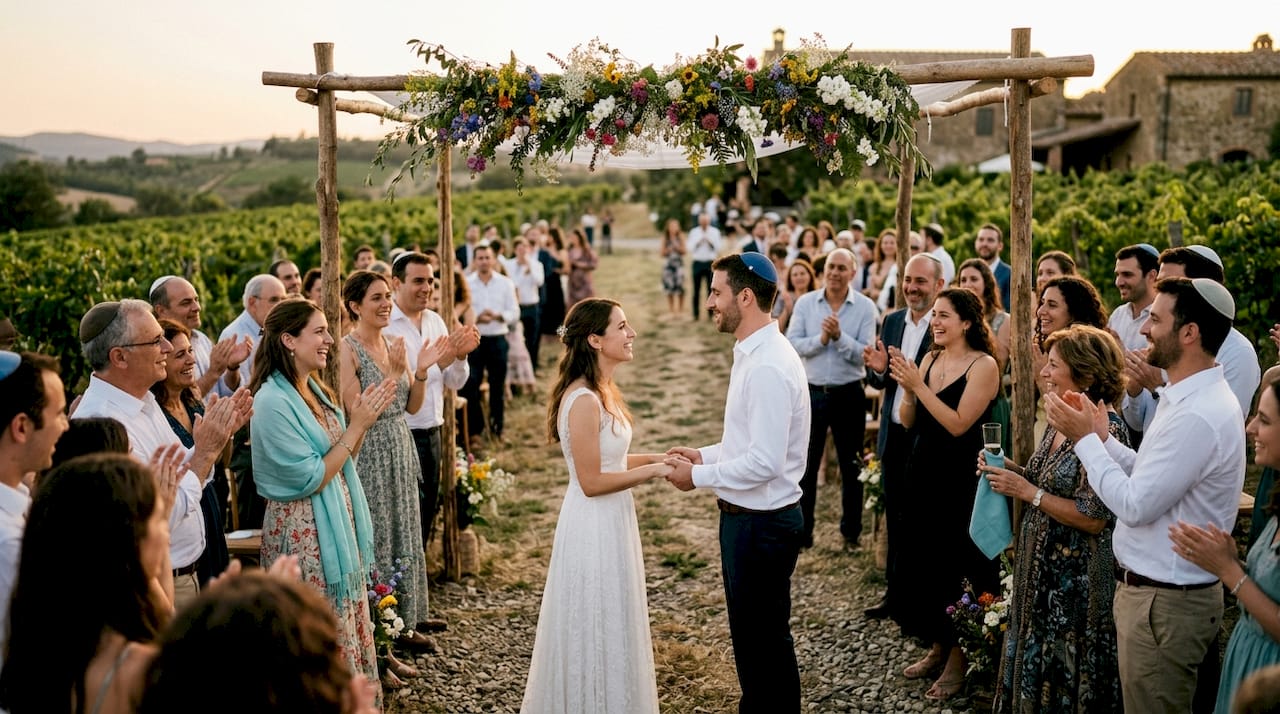
Weddings in Israel are typically large. Guest lists of 200–400 people are not unusual, and the celebration often continues until the early hours of the morning. The communal dimension is central: a wedding is not just a union of two people but a joining of two families and their extended networks.
How do Israeli families celebrate major holidays?
The Jewish holiday calendar is the backbone of Israeli family life. Holidays don’t just mark religious observances; they structure the entire year, create shared memories across generations, and pull the community together in ways that feel genuinely different from American holiday culture. Children absorb cultural identity through daily life and holiday cycles seen in streets and public spaces, which means the holidays are never just a family dinner. They’re visible, public, and participatory.
Shabbat: the weekly anchor
Shabbat begins at sundown on Friday and ends after nightfall on Saturday. It is the most frequently observed Jewish tradition in Israel, crossing secular and religious lines. Most stores and many restaurants close. Public transportation stops in most cities. Families gather for a Friday night dinner that typically includes challah bread, wine or grape juice, and a full meal. The specific dishes vary by ethnic background: Ashkenazi families might serve chicken soup and gefilte fish, while Mizrahi families often prepare slow-cooked stews, rice dishes, and spiced meats. Shabbat creates a weekly rhythm that fosters family unity and communal time in a way that no other tradition quite matches.
Passover and the Seder
Passover (Pesach) falls in March or April and lasts eight days. The highlight is the Seder, a ritual meal held on the first night (and often the second) that retells the story of the Exodus from Egypt through the reading of the Haggadah, symbolic foods, songs, and discussion. More than 95% of Israelis attend a Seder every year on Passover, making it the most universally observed Jewish ritual in the country. During the holiday, regular bread and leavened products disappear from most stores, and even fast-food chains replace their buns with matzah-based alternatives.
Every family’s Seder has its own personality. Some race through the Haggadah to get to dinner. Others debate the text until midnight. The Seder plate holds bitter herbs (maror), charoset (a sweet paste of fruit and nuts), a lamb shank bone, a hard-boiled egg, and parsley, each carrying symbolic meaning tied to the Exodus story.
Purim
Purim, celebrated in February or March, commemorates the saving of the Jewish people from Haman’s plot as recorded in the Book of Esther. The holiday involves reading the Megillah (Book of Esther) in synagogue, wearing costumes, delivering mishloach manot (gift baskets of food) to friends and neighbors, giving charity, and holding a festive meal. In Israel, Purim spills into the streets. Cities like Tel Aviv host massive outdoor celebrations with costumes, music, and parades that go on through the night. Children start celebrating days early, with school costume parties building anticipation. It’s the closest thing Israel has to a carnival.
Sukkot
Sukkot, which falls five days after Yom Kippur in September or October, commemorates the Israelites’ 40 years of wandering in the desert. Families build temporary outdoor structures called sukkot (singular: sukkah) on balconies, in yards, and outside restaurants, decorating them with hanging fruits, paper chains, and artwork. Meals are eaten inside the sukkah throughout the week. The holiday also involves the Four Species: an etrog (citron), lulav (palm branch), hadas (myrtle), and arava (willow), which are waved together during prayer. In Jerusalem, sukkot appear on nearly every balcony and sidewalk, transforming the city’s visual landscape for a full week.
Rosh Hashanah and Yom Kippur
Rosh Hashanah, the Jewish New Year, is marked by the sounding of the shofar (a ram’s horn) during synagogue services, festive family meals, and symbolic foods including apples dipped in honey, round challah, and pomegranates. Yom Kippur, ten days later, is the holiest day in the Jewish calendar. Israel essentially shuts down: no cars on the roads, no public transportation, businesses closed. Families fast for 25 hours and spend much of the day in synagogue. The experience of walking down the middle of a normally busy street in complete silence is one of the most striking things a visitor to Israel can witness.
Pro Tip: If you’re visiting Israel during Passover, plan your grocery shopping before the holiday starts. Bread and leavened products disappear from most supermarket shelves for the full week, and restaurants may offer limited menus. Stock up on matzah, fresh produce, and Kosher for Passover staples before the Seder night.
Food is central to every holiday, and the specific dishes vary significantly by ethnic background. Ashkenazi Hanukkah celebrations feature latkes (potato pancakes), while Israeli culture has broadly adopted sufganiyot (jelly-filled doughnuts) as the holiday’s signature food. Sephardic and Mizrahi families bring their own holiday recipes, from slow-cooked lamb for Rosh Hashanah to spiced rice dishes for Passover. Understanding local cuisine as part of cultural visits is one of the most direct ways to connect with Israeli family traditions, since food carries the memory of diaspora communities in every bite.
What is the Israeli communication style within families?
Israeli communication is direct. Not blunt in a rude way, but genuinely, efficiently honest in a manner that can catch Americans off guard. This style has a name: the Sabra personality, named after the prickly pear cactus that is tough on the outside and sweet inside. The Sabra communication style reflects a culturally valued directness and authenticity that accelerates building genuine relationships in families and social settings.
Within families, this directness shows up constantly. Parents tell children exactly what they think. Grandparents offer unsolicited opinions on everything from career choices to haircuts. Siblings argue loudly and make up quickly. Debate is not a sign of conflict; it’s a sign of engagement. An Israeli family dinner where everyone agrees on everything would feel oddly quiet.
Personal boundaries are also more fluid than most Americans are used to. Strangers engage openly as an extension of communal family spirit rather than intrusion. Someone you’ve just met at a Shabbat dinner might ask about your salary, your relationship status, or your plans for children within the first hour. This isn’t nosiness in the American sense. It’s a reflection of a collective mindset where community membership means genuine interest in each other’s lives.
Gender dynamics within Israeli families are shifting but still varied. In secular and liberal communities, household roles tend to be more egalitarian, with both partners working and sharing domestic responsibilities. In traditional and Ultra-Orthodox communities, gender roles follow more defined lines, with women typically managing the home and children while men focus on religious study or work. These differences are significant and worth understanding before you visit or engage with Israeli families across different communities.
How does hospitality work in Israeli family culture?
Israeli hospitality is not a performance. It’s a reflex. If you’re at someone’s home when mealtime arrives, you will be fed. If you drop by unannounced, you will be welcomed. The open-door policy for meals is genuine: unexpected visitors are welcomed and meals expand accordingly. This spontaneous hospitality is culturally expected, not exceptional.
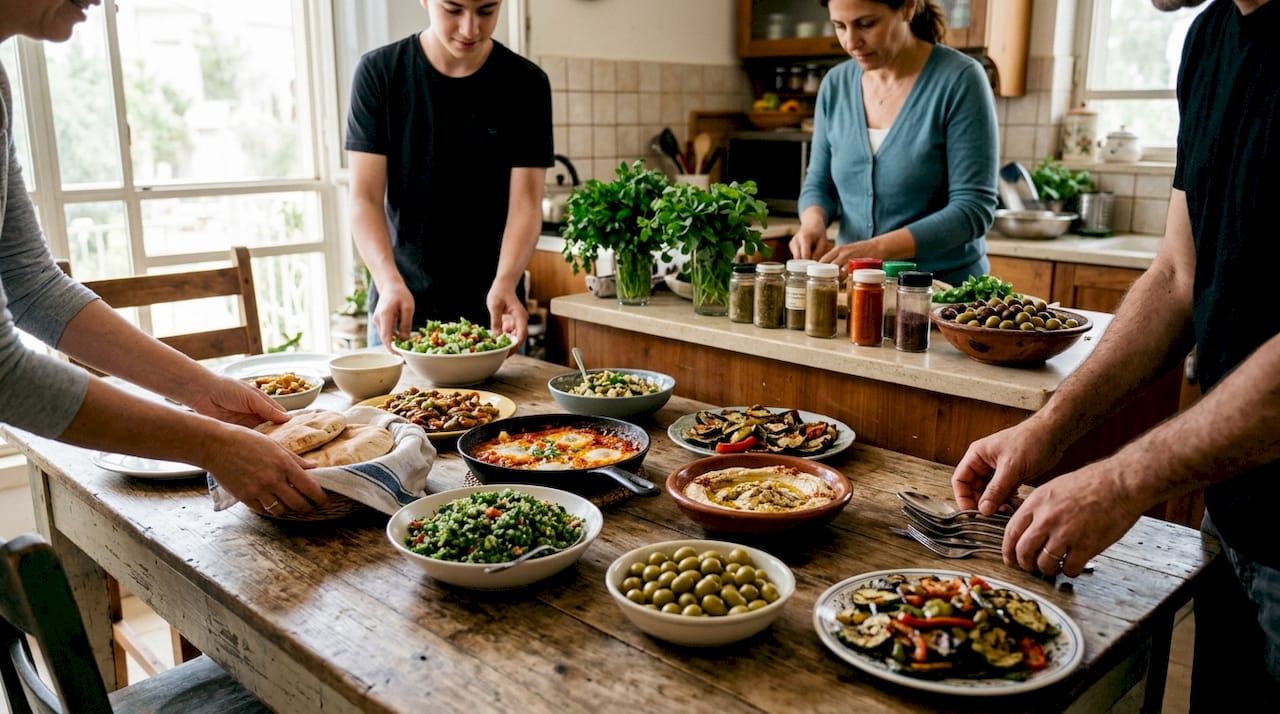
When you’re invited to an Israeli home, bringing a modest gift is appreciated but not required. Wine, chocolates, flowers, or a box of pastries all work well. Timing is flexible by American standards. An invitation for 7:00 PM means guests will likely arrive between 7:30 and 8:00 PM, and nobody will think less of you for it. The meal itself will be generous, with multiple courses and persistent offers of more food.
Communal celebrations extend well beyond the nuclear family. A birthday party, a holiday meal, or a lifecycle event will typically include neighbors, friends, colleagues, and anyone who happens to be in town. The concept of a guest list in the exclusive sense doesn’t translate well to Israeli culture. The more people around the table, the better.
Food sits at the center of every gathering. Shared meals are how Israeli families build and maintain relationships, welcome strangers into their circle, and mark every occasion from a casual Friday night to a major lifecycle event. The culinary dimension of Israeli culture is inseparable from its hospitality traditions, with each ethnic community contributing dishes that tell the story of where the family came from.
Public family life is also highly visible in Israel. Families eat together in restaurants, gather in parks and plazas, and participate in communal events in ways that keep family life out in the open rather than behind closed doors. This visibility reinforces community belonging and gives children a constant sense of being part of something larger than their household.
How do holiday rituals express Israeli national family identity?
The most striking thing about Israeli holiday culture, once you step back and look at it, is that it functions as a form of national family-making. Holidays aren’t just observed within households. They’re performed publicly, communally, and with a shared script that crosses religious and secular lines.
The Passover Seder is the clearest example. Cultural scholar Hizky Shoham, writing for Bar-Ilan University’s research center, analyzes how the Seder functions as a national ritual imagining the Jewish people as one extended family. The conformist reading of the Haggadah largely follows Orthodox rules even in secular families, symbolizing national family unity across all sectors of Israeli society. A secular family in Tel Aviv and an Ultra-Orthodox family in Jerusalem are reading from the same text, eating the same symbolic foods, and reciting the same story on the same night. That shared script is what makes the Seder a national event, not just a religious one.
This dynamic extends beyond Passover. Yom Kippur turns the entire country’s streets into pedestrian spaces. Sukkot fills balconies and sidewalks with decorated booths. Purim transforms city centers into street parties. Each holiday has an outward-facing, community dimension that makes it impossible to observe privately even if you wanted to. Holiday rituals are communal performances that reinforce shared Jewish national identity, not limited to private family occasions but community-wide celebrations.
For American families visiting Israel, this national familism is one of the most powerful things to witness firsthand. You’re not watching someone else’s family celebrate. You’re being pulled into a collective experience that has been practiced, in various forms, for thousands of years. The role of tradition in Jewish travel is precisely this: it gives visitors a way to connect with something larger than a tourist itinerary.
The diversity of modern Israeli society actually makes these communal holiday moments more striking, not less. Ashkenazi, Sephardic, Mizrahi, Ethiopian, and Russian Jewish communities each bring their own customs, foods, and melodies to the same holidays. The result is a holiday culture that is simultaneously unified and richly varied, a national family with many different accents.
Celebrate your family’s milestone where these traditions come alive
If you’re planning a Bar or Bat Mitzvah and want your child to experience Israeli family traditions not as a textbook lesson but as a lived reality, Bneimitzvahtrip brings that experience directly to your family.
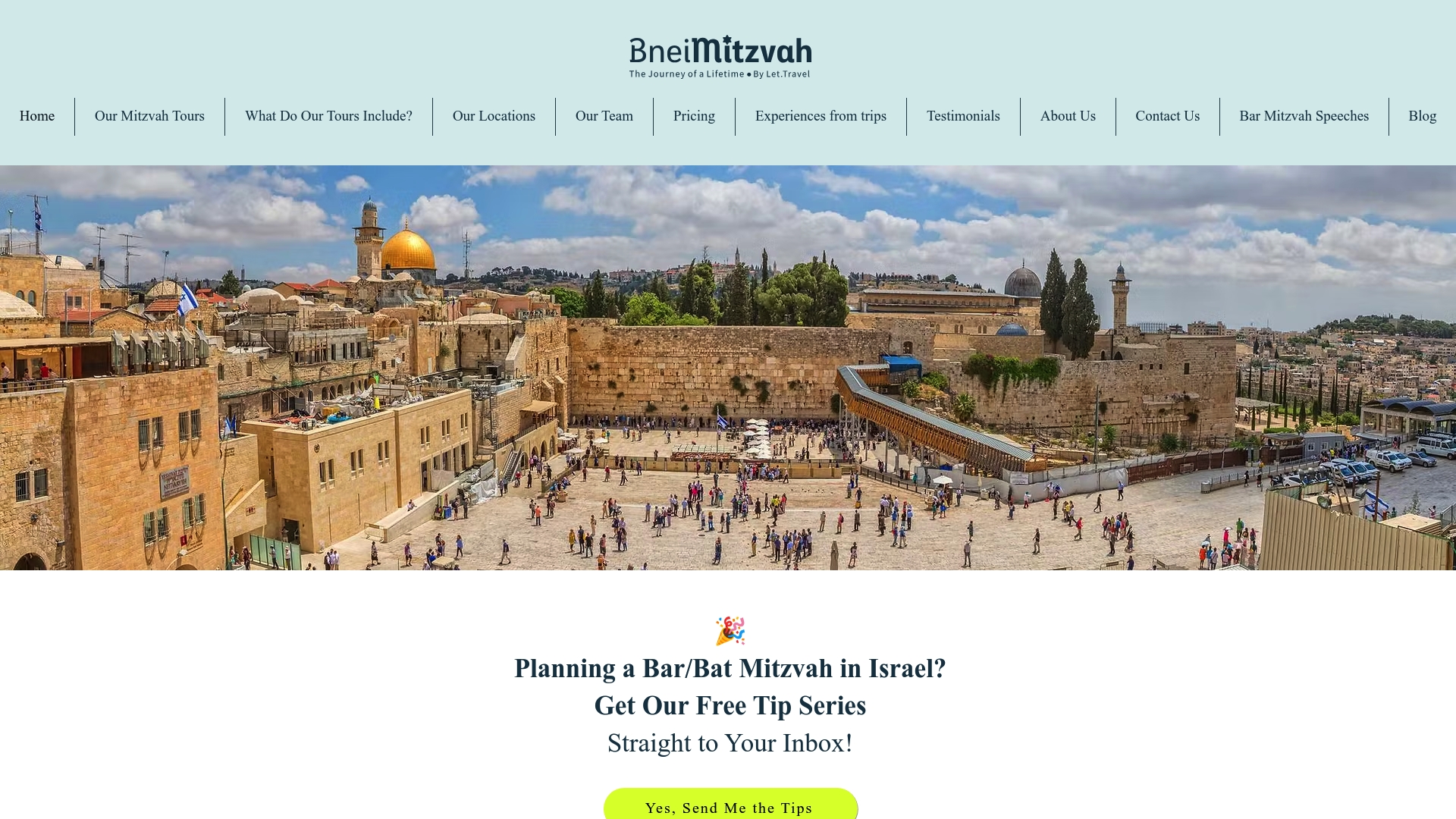
With over 20 years of expertise in tourism, event planning, and experiential travel, Bneimitzvahtrip designs Bar and Bat Mitzvah tours that place your family inside the traditions described in this guide. Your child reads from the Torah at the Western Wall. Your family shares a Shabbat meal with Israeli hosts. You visit the sites where Jewish history became Jewish identity. Every element of the trip connects the milestone moment to the living culture that gives it meaning.
Bneimitzvahtrip’s planned Bar Mitzvah tours combine meaningful locations, inspiring stories, exciting activities, and exceptional culinary experiences into a single family journey. The result is a celebration that resonates long after the party ends.
Key Takeaways
Israeli family traditions are strongest when understood as a system: family structure, lifecycle events, holiday observance, and communal hospitality all reinforce each other to create a culture where belonging is felt daily, not just on special occasions.
Point | Details |
Family size tracks religious observance | Secular Jewish couples typically have 1–3 children; traditional or religious families tend to have 3–6; Ultra-Orthodox families often have 7 or more. |
Grandparents are active, not peripheral | Extended family engagement shapes child-rearing and daily life, especially in religious and Mizrahi communities. |
Passover Seder is a national ritual | More than 95% of Israelis attend a Seder annually, with the Haggadah read in both secular and religious homes. |
Sabra directness is cultural, not rude | Israeli communication values honesty and efficiency; fluid personal boundaries reflect a collective family mindset. |
Hospitality is spontaneous and open | Unexpected guests are welcomed and meals expand; bringing a modest gift is appreciated but not required. |
Recommended
Comments