What is cultural travel? A guide for Mitzvah families

TL;DR:
Cultural travel in Israel involves engaging deeply with heritage sites, arts, language, and community experiences, beyond simple sightseeing. It fosters meaningful connections to Jewish identity and ensures a transformative milestone for Bar and Bat Mitzvah families. Planning with intentionality and participation creates memorable experiences that shape lifelong relationships with Israeli and Jewish culture.
Many parents planning a Bar or Bat Mitzvah trip to Israel picture the obvious highlights: a visit to the Western Wall, a float in the Dead Sea, maybe a walk through the Old City of Jerusalem. That’s a wonderful start, but it barely scratches the surface of what Israel can offer your family during this once-in-a-lifetime milestone. Cultural travel goes far deeper than famous landmarks, and understanding the difference can turn a good trip into a truly transformative one that your child will carry into adulthood.
Table of Contents
Key Takeaways
Point | Details |
Active engagement is key | Cultural travel means seeking hands-on, meaningful cultural experiences, not just sightseeing. |
Look for variety | Combine heritage, language, food, and real local interactions for the richest Bar/Bat Mitzvah trip. |
Plan for depth | Choose tours and activities that give context, encourage participation, and connect your family to living traditions. |
Evaluate tour structure | Review itineraries for time spent on both tangible sites and immersive, intangible experiences. |
Defining cultural travel: More than just sightseeing
After introducing the purpose and promise of cultural travel for Mitzvah families, let’s clarify what this term truly means.
Most people use “cultural travel” loosely to mean any trip that involves old buildings or historical sites. But international standards set a much richer bar. Cultural tourism encompasses heritage sites, crafts, languages, performing arts, gastronomy, festivals and special events, and museums, among many other dimensions. In other words, it is a whole ecosystem of human expression, not just stone and mortar.
“Cultural travel is not just ‘being in culture.’ It is primarily about the visitor’s essential motivation to learn and experience cultural attractions at a deeper level.”
That distinction matters enormously for Mitzvah families. The goal is not simply to be near culture. It is to engage with it, question it, taste it, and bring it home inside your hearts. When your family connects cultural identity with Israeli heritage, the Bar or Bat Mitzvah stops being a ceremony and becomes the beginning of a lifelong relationship with Jewish identity.
Key elements that define authentic cultural travel include:
Heritage sites with guided, context-rich storytelling
Artisan workshops where families make something with their own hands
Gastronomy that explores the food traditions of Israeli and Jewish communities
Performing arts and music rooted in the local culture
Language immersion, even brief Hebrew interactions with locals
Festivals and living events that connect visitors to real community rhythms
Active participation, not passive observation
Cultural travel vs. regular tourism: What’s the difference?
With cultural travel defined, let’s see how it really stands apart from regular tourism, especially in the context of planning your child’s Mitzvah trip.
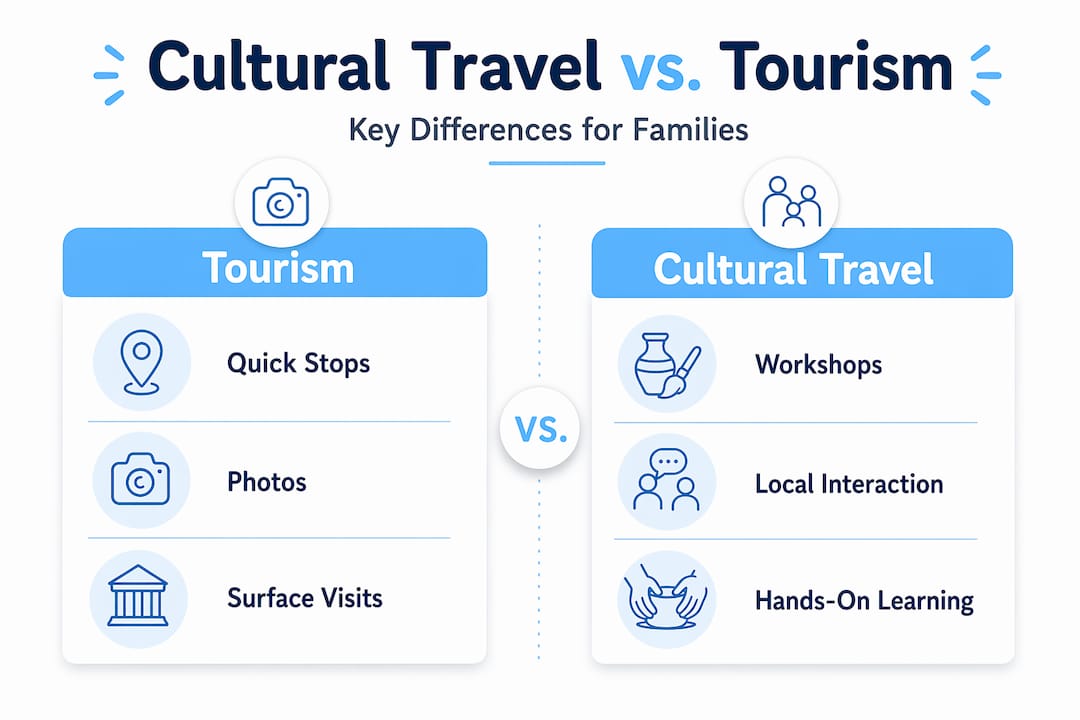
The core difference comes down to motivation and structure. Cultural travel is primarily about the visitor’s motivation to learn and experience cultural attractions, not simply to photograph them. Regular tourism is not bad. It just rarely creates the depth of memory that a Mitzvah milestone deserves.
Experience | Regular tourism | Cultural travel |
Western Wall visit | Quick stop, group photo | Guided prayer, personal reflection, learning the Wall’s history |
Shuk Machane Yehuda | Walk through, buy a snack | Cooking class with a local chef, tasting traditional foods |
Tel Aviv neighborhood | Bus window view | Walking tour with a local artist or community guide |
Dead Sea | Float, tick it off the list | Learn about the region’s ecology and Jewish geography |
Israeli music | Background noise at a restaurant | Live performance with story context from the musician |
The shift in experience is not about doing more. It is about doing things differently, with intention.
Pro Tip: When reviewing a proposed Mitzvah tour itinerary, look for the word “workshop,” “guided,” “community,” or “interactive.” Those words signal the operator understands the difference between watching and participating. You can explore what experiential travel for Bar Mitzvahs really looks like in practice before you commit to any package.
Also take note of the variety of Israel trip attractions available. A strong itinerary will mix spiritual, historical, culinary, and creative experiences rather than clustering everything around a single theme.
Elements of meaningful cultural travel in Israel
Knowing that cultural travel is about intention and engagement, here are the actual experiences in Israel that bring this to life for Bar and Bat Mitzvah families.
Israel is genuinely one of the most culturally layered destinations on the planet. Within a single day, a family can move from ancient archaeological ruins to a vibrant contemporary art scene, from a synagogue to a Bedouin hospitality tent. That richness is a gift, but only if the trip is designed to unlock it.
Research consistently shows that families who engage deeply with heritage during milestone trips report stronger identity outcomes. In surveys of families who have taken cultural tours, 85% say that cultural elements meaningfully enriched their child’s Jewish identity. That is not a minor footnote. It is the whole point.
Cultural tourism encompasses heritage sites, crafts, languages, performing arts, gastronomy, festivals, and museums. For Mitzvah families in Israel, this translates into a rich checklist of possible experiences:
Experience type | Israel example | Why it matters |
Heritage site visit | Masada at sunrise | Connects Jewish resilience and history |
Artisan workshop | Pottery or mosaics in the Galilee | Hands-on, creative memory making |
Food immersion | Shabbat dinner with a local family | Living tradition, not museum-style learning |
Festival participation | Lag B’Omer bonfire or Purim celebration | Real-time community belonging |
Hebrew immersion | Simple market interactions in Hebrew | Language is a living bridge to identity |
Community service | Volunteering at a local social project | Turns “Mitzvah” from word to action |
You can watch real families experience these moments through Bar and Bat Mitzvah tour videos to get a feel for the energy these activities bring. Families with diverse needs or different ages can also explore inclusive tour ideas to ensure every family member is fully engaged. And if you are wondering about the logistics, reviewing what a Mitzvah tour includes gives a clear picture of how these experiences are structured.
How to evaluate and plan a culturally rich Mitzvah trip
You now know what cultural travel really is and what makes it meaningful. Here is how to ensure your family’s trip delivers on that promise.
The planning stage is where most families either set themselves up for a transformative experience or accidentally book a glorified photo tour. Asking the right questions before you commit makes all the difference. Assess how much time is devoted to tangible heritage versus living culture, and whether activities are structured for learning. Here is a practical framework:
Define your family’s goals. What do you want your child to feel, know, or remember six months after returning home? Articulating this guides every other decision.
Review proposed itineraries line by line. Look for time allocated to hands-on activities, not just travel and viewing time.
Ask about guides. A knowledgeable, passionate local guide transforms every stop. Ask operators specifically about guide qualifications and storytelling approach.
Check for community interaction. Visits that include local families, artists, chefs, or educators add layers that no museum exhibit can replicate.
Balance heritage with living culture. Ancient sites are essential, but balance them with contemporary Israeli life for a full picture.
Plan for reflection. Build in family moments to talk about what you have experienced. Culture absorbed without reflection fades quickly.
Pro Tip: Check your accommodation strategy early. Staying in neighborhoods rather than resort areas often doubles your cultural exposure without any extra effort. Reviewing accommodation tips for family tours can help you make smarter decisions about where you sleep.
Also consider weaving in a dimension of spiritual meaning. Israel’s spiritual geography is extraordinary, and spiritual tourism ideas can help you identify the moments that will resonate most deeply with your family.
Why most families miss the power of true cultural travel
Given all these insights and guidelines, why do so many families still wind up with unmemorable trips?
The honest answer is habit. We are conditioned by decades of vacation culture to treat travel as a checklist. “We went to Jerusalem. We saw Masada. We floated in the Dead Sea.” There is a photo for each one, and the trip is done. The problem is not the places. The problem is the approach.
Cultural travel depends on the visitor’s essential motivation to learn and engage at a deeper level. Without that motivation built into the trip structure, even the most spectacular destination becomes forgettable background scenery. Families who report the most powerful Mitzvah trips share one thing: they went looking for connection, not content.
The families we have worked with who describe their trips as life-changing are not always the ones with the biggest budgets or the longest itineraries. They are the ones who sat with an Israeli family for Shabbat dinner, who helped a local charity for an afternoon, who let their teenager lead a moment of the trip with the autonomy to explore what they found meaningful. That is the thing most travel packages do not tell you: your child’s own curiosity is the most powerful cultural guide of all.
Planning with intention does not require more time. It requires different questions. And asking those questions before you book is the entire difference between a trip that fades into a photo album and one that shapes who your child becomes.
Plan your family’s unforgettable cultural Mitzvah journey
Ready to plan a Mitzvah trip that truly connects your family with Israel’s living culture?
At Bnei Mitzvah, we have spent over 20 years designing experiences that go far beyond sightseeing. Every itinerary we build layers heritage, living culture, family connection, and spiritual meaning into a cohesive journey your whole family will feel for years. You can explore our Bar Mitzvah tour options or discover Bat Mitzvah tours designed specifically for this milestone.
Browse all Bar and Bat Mitzvah tour packages to find the right fit, or reach out to our team directly to talk through a custom journey built around your family’s goals. We are here to make sure your child’s Mitzvah in Israel is exactly as meaningful as this milestone deserves to be.
Frequently asked questions
What makes a Mitzvah trip in Israel truly “cultural”?
A truly cultural Mitzvah trip combines heritage sites with hands-on experiences, local interaction, and family learning that goes well beyond typical sightseeing. According to established standards, cultural tourism encompasses crafts, languages, gastronomy, festivals, and performing arts alongside historical monuments.
How can my family participate in “living culture” on a trip?
Choose activities like food workshops, live music events, community volunteering, or brief Hebrew language sessions to move from observation into genuine cultural participation.
Is cultural travel appropriate for children and teens?
Yes, and it is especially well-suited for them. Cultural travel programs designed for families engage all ages through active learning, creative workshops, and identity-building experiences that feel exciting rather than academic.
How do I know if a tour is truly focused on culture?
Check that the itinerary blends tangible heritage with interactive, guided context. Strong tours devote structured time to both historic sites and living cultural engagement rather than relying only on photo stops.
Recommended
Comments