What Is a Guided Spiritual Journey? A Clear Guide
- שי דוד

- 11 minutes ago
- 7 min read

TL;DR:
A guided spiritual journey is a structured, facilitated inner exploration involving practices like breathwork, sound healing, and somatic movement that foster deep awareness and emotional processing. These sessions typically follow a three-part format—intake, active process, and integration—and support spiritual growth through recurring stages of departure, initiation, and return, emphasizing the importance of proper facilitation and post-session reflection. Anyone can participate regardless of background, with genuine transformation emerging through consistent practice and respectful, neutral guidance that creates a safe space for authentic inner work.
A guided spiritual journey is a facilitated inner exploration where a trained guide helps you access deeper states of awareness, process emotional material, and reconnect with your own sense of meaning and purpose. Unlike self-directed meditation or casual spiritual reading, this process uses structured formats, qualified facilitators, and specific techniques to create conditions for genuine inner transformation. Practices like breathwork, sound healing, and somatic movement are the primary vehicles. No prior religious background is required, and the experience applies equally to someone raised in a Jewish household, a secular seeker, or anyone in between.
What does a guided spiritual journey session typically involve?
A guided spiritual journey session follows a three-part structure: intake, active process, and integration. Standard sessions run about 60 minutes, typically broken into a 10-minute intake to set intention, a 40-minute active journey using breathwork, meditation, or sound healing, and a 10-minute integration window for reflection. That structure matters because it creates psychological safety before the deeper work begins.

Intensive formats extend this considerably. Retreats can span 5 hours daily or run across multiple days, allowing participants to move through layers of experience that a single session cannot reach. Think of a 60-minute session as a single chapter and a multi-day retreat as the full book.
Facilitation happens in small groups or one-on-one settings, with the guide acting as a container rather than a teacher. The guide does not tell you what to believe or feel. They hold the space steady while you do the actual inner work. This distinction separates genuine spiritual facilitation from religious instruction or life coaching.
Pro Tip: Set a specific intention before your session, even something as simple as “I want to understand what is blocking my sense of peace.” Vague intentions produce vague results.
Embodiment practices like breathwork and group mirroring are particularly effective because they make spiritual experience tangible in the body, not just conceptual in the mind. You process energy in real time rather than analyzing it afterward.
How do guided spiritual journeys support spiritual growth stages?
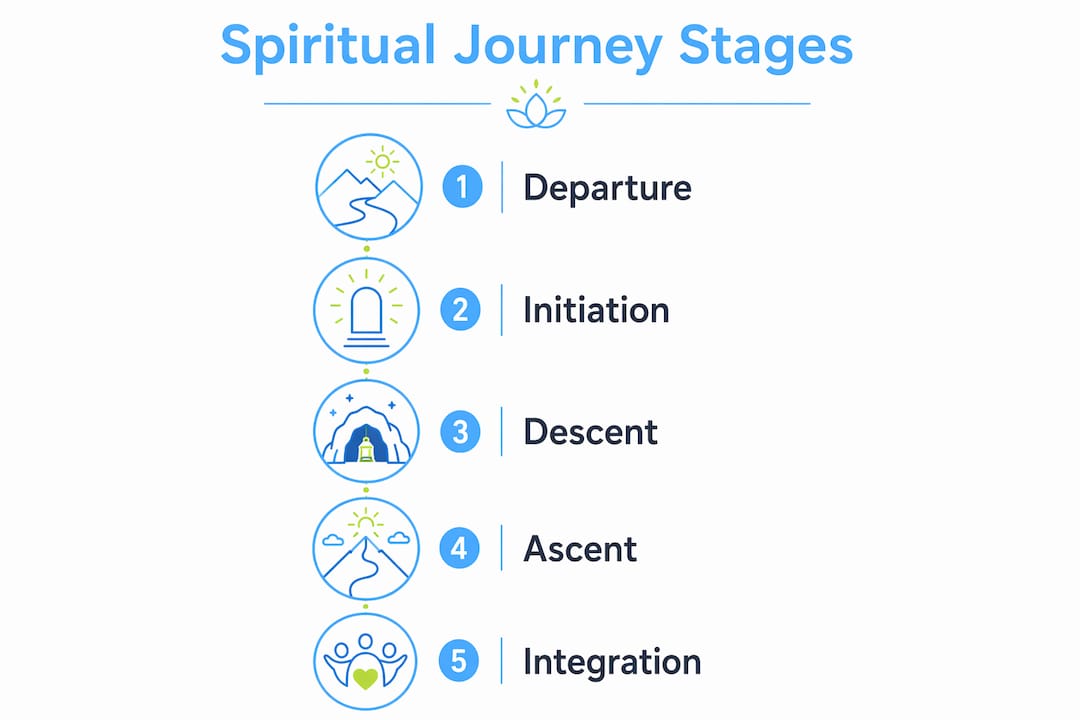
Spiritual growth follows a recognizable arc. Most frameworks identify three to five core stages: Departure, Initiation, and Return. These are not rungs on a ladder. They are territories you revisit throughout life, each time with more depth and less resistance.
Stage | Focus | Role of the guide |
Departure | Setting intention, leaving the familiar | Creates safe container for the threshold |
Initiation | Deep inner work, shadow processing | Holds space without directing the outcome |
Return | Integration, embodying new awareness | Supports grounding and practical application |
The Departure stage is where you consciously choose to look inward. The Initiation stage is where the real work happens, often involving discomfort, emotional release, or confronting old patterns. The Return stage is where insights become lived behavior rather than interesting ideas.
Spiritual development is not hierarchical. Each stage carries its own gifts and challenges, and no stage is superior to another. Trying to skip the Initiation phase to reach the clarity of Return is the most common mistake serious seekers make.
Pro Tip: After a session, resist the urge to immediately explain your experience to others. Give yourself 24 hours of quiet processing before you put words to what happened.
A facilitator’s job during these stages is to act as a neutral container without imposing dogma. Ethical guidance means no agenda, no projection, and full respect for your own inner authority. That neutrality is what makes the process safe enough for genuine depth.
What are the benefits and common experiences during guided spiritual journeys?
The benefits of guided spirituality are real, but they rarely look the way beginners expect. Most newcomers anticipate immediate peace or ecstatic insight. What they often encounter first is the opposite.
“The descent phase, often uncomfortable, is necessary dismantling for new spiritual growth. Recognizing this as transformational avoids discouragement among newcomers.” Source
Shadow work, the process of meeting and integrating suppressed emotional material, is not a sign that something has gone wrong. It is the positive marker of transformation. The discomfort signals that old patterns are actually releasing rather than just being rearranged.
Common experiences and benefits include:
Emotional release: Grief, anger, or relief that has been stored in the body finally moves through.
Clarity: A felt sense of direction or purpose that intellectual analysis alone cannot produce.
Deeper self-connection: Access to your own inner compass rather than reliance on external validation.
Reduced dependency: True guidance reconnects you with your own inner compass rather than creating reliance on a teacher or tool.
Post-session integration: The most profound shifts often surface in the days after a session, not during it.
The integration phase is where lasting change occurs. Rest, journaling, and reduced social stimulation in the 24 to 48 hours after a session allow insights to settle into the nervous system. Skipping integration is like planting seeds and immediately paving over the soil.
Understanding why spiritual journeys transform identity helps set realistic expectations before you begin. Transformation is rarely a single moment. It is a cumulative process built session by session.
How can you begin and make the most of a guided spiritual journey?
Starting a guided spiritual journey process does not require a dramatic life change or an expensive retreat. It requires intention, a qualified guide, and a willingness to stay present with whatever arises.
Practical steps to begin:
Choose a qualified facilitator. Look for someone trained in somatic or contemplative practices, with clear ethics around consent and boundaries. Credentials matter less than their demonstrated ability to hold space without imposing their own framework.
Set a clear intention. Decide what area of your inner life you want to explore. Healing grief, deepening faith, or understanding a recurring pattern are all valid starting points.
Schedule integration time. Block at least two hours after any session for rest and quiet reflection. Treat it as part of the session, not optional recovery time.
Avoid the bliss trap. Expecting instant peace sets you up to dismiss genuinely valuable difficult experiences as failures.
Stay consistent. A single session opens a door. Regular practice over months is what produces lasting change.
Experiential travel packages increasingly incorporate guided spiritual journey techniques into structured itineraries, making it possible to combine deep inner work with meaningful locations. For families marking a milestone like a Bar or Bat Mitzvah, this combination carries particular power.
Pro Tip: Keep a dedicated journal for your spiritual journey process. Write immediately after sessions, before you analyze or edit. Raw impressions often contain the most useful material.
Experiential learning approaches that combine physical place, community, and guided reflection produce deeper integration than solo practice alone. The body remembers what it experiences in a meaningful location far longer than what it reads in a book.
Key takeaways
A guided spiritual journey works because structured facilitation, intentional practice, and dedicated integration time together produce transformation that self-directed reading or casual meditation rarely achieves.
Point | Details |
Structured session format | Standard sessions follow intake, active process, and integration across roughly 60 minutes. |
Cyclical growth stages | Departure, Initiation, and Return repeat throughout life; no stage is superior to another. |
Shadow work is progress | Discomfort during the descent phase signals genuine transformation, not failure. |
Integration drives change | The most lasting shifts occur in the 24 to 48 hours after a session, not during it. |
No prior experience needed | Guided spiritual journeys are open to all backgrounds with no religious prerequisite. |
What 20 years of watching families transform in sacred places taught me
Most people arrive at a guided spiritual experience expecting to be taught something. What actually happens is closer to remembering something. The most powerful moments I have witnessed are not when someone receives new information. They are when someone recognizes a truth they already carried but had never been given the space to feel.
The families who get the most from these experiences are not the ones who arrive with the most spiritual knowledge. They are the ones who arrive with the most honest questions. A teenager standing at the Western Wall for the first time, genuinely asking what this place means to their family, is doing more real spiritual work than an adult reciting prayers from memory without presence.
My honest recommendation: do not wait until you feel ready. Readiness is not a prerequisite for a guided spiritual journey. Willingness is.
— Shay
Experience a guided spiritual journey with Bneimitzvahtrip

Bneimitzvahtrip designs Bar and Bat Mitzvah tours in Israel that go far beyond sightseeing. Each itinerary weaves guided spiritual experiences into meaningful locations, from the ancient stones of Jerusalem to the shores of the Sea of Galilee, with expert facilitators who understand how to hold space for families at a milestone moment. Sessions are structured for small groups, with dedicated integration time built into every day. The result is a spiritual journey process that the whole family carries home, not just a collection of photographs. If your family is ready to mark this milestone with genuine depth, explore our planned tours and find the experience that fits your family’s story.
FAQ
What is a guided spiritual journey?
A guided spiritual journey is a structured, facilitated inner exploration using practices like breathwork, meditation, or sound healing to support personal growth and spiritual awareness. A trained guide holds the space while you do the inner work, without imposing beliefs or direction.
How long does a guided spiritual journey session last?
Standard sessions run approximately 60 minutes, divided into intake, active process, and integration. Intensive retreat formats can extend to 5 hours daily or span multiple days.
Do I need religious experience to start a spiritual journey?
No prior religious background is required. Guided spiritual journeys are designed for seekers of all backgrounds and focus on direct inner experience rather than doctrine or belief systems.
What is shadow work in a spiritual journey?
Shadow work is the process of meeting suppressed emotional patterns during the descent phase of a spiritual journey. Discomfort during this phase is a recognized marker of genuine transformation, not a sign that something has gone wrong.
How do I choose a qualified spiritual journey facilitator?
Look for a facilitator trained in somatic or contemplative practices who demonstrates clear ethical boundaries, consent-based facilitation, and no imposition of personal dogma. Ethical facilitation centers on safety and neutrality.
Recommended
Comments